Film Daze
a short reflexion on tools and change
I’m finally reading Sally Mann’s autobiography Hold Still, which had been sitting on my wish list for years. I’ve always felt a kinship to her work—probably because of Immediate Family, and this almost obsessive focus we shared—but I’m surprised to discover how deep the connection goes. So heads up folks: chances are this isn’t the last post you’ll see inspired by this book.
In the pages I read last night, she talks about a 19th century civil war photographer, Michael Milley, whose glass plates she’d found in an attic and restored over the years. She speaks of her own kinship with this photographer who, like her, was infatuated by the light, air, mountains, and rivers of the Deep South. He’d even shot in some of the exact same locations, too, including her family farm. Generational serendipity.
At one point she mentions a heavily processed plate of his, as a source of great inspiration:

From Hold Still.
As you can see it features solarized areas, and burnt white borders—achieved either through chemicals or light leaks (I don’t know and she doesn’t explain). But she waxes poetic about the overall effect, and writes the following:
Try getting a picture like that with conventional film or, even more unlikely, with a digital camera or your phone.
It’s a rare instance (so far) where I’ve found myself in total disagreement. I don’t like this particular image—I find the look more garish than pretty—but that’s subjective, and besides the point. What strikes me is the gulf that can exist between photographers of the film age and those of the digital era. Namely, how irrevocably shaped we are by our tools, and how they alter the way our minds deconstruct the photographic workflow.
Looking at that image, I see nothing that isn’t a couple of sliders or layer effects away, in even the simplest image editor. But for Mann, achieving this look became a long-term quest, a dance to first decipher, and then execute, through trial and error. She shows a picture she took—forty years later!—where she finally achieved those “leaked borders”:
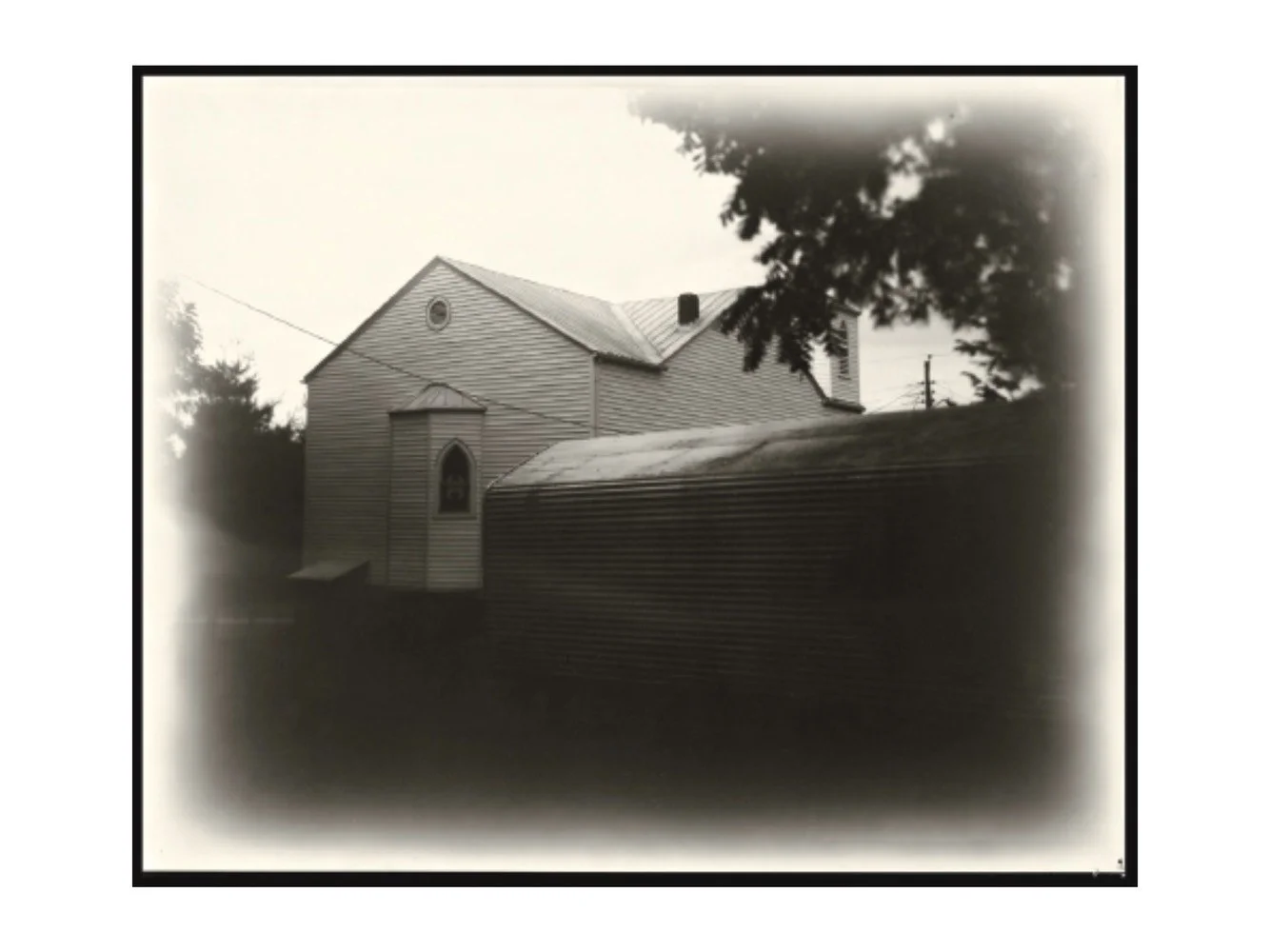
From Hold Still. © Sally Mann.
I prefer her version—by far—but I’m still puzzled by her awe of it.
...
Later, she describes her journey through the Mississippi landscape, in a suburban van filled with gear, with a makeshift lab at the back. The amount of material she was carrying—highly flammable for the most part—is simply mind-boggling. The amount of waste it implies as well. Of time.
Seeing remains seeing. The prescience, the tingling senses as those milliseconds pass, as the air becomes suddenly electric with the impending possibility of an image, none of this has changed, and it likely never will. But the craft of photography has shifted so, so far away from the reality described in these memoirs. Much of what once required years of practice in a darkroom, scribbling notes on endless test prints, hoping for a flawless execution, all of that is now mostly an afterthought. Not in terms of importance, but in terms of process. Ours is a non-destructive world, with every component of an image pliable, ready for deconstruction and re-assembly. We think in moveable layers and masks, not in emulsions or enlargers. The result has been a redefining of how we capture the world because, ultimately, it has altered the steps required to achieve an image. We now use a wholly different set of skills, attained through a new language.
And yet, still… the art remains. I find this fascinating.
One final note: if anyone tells you film was much simpler, and processing digital files is a PITA…let me know. I’ve got a few choice chapters I can share.
;)